


Ghosts of Women Past
- Jan 25, 2017
- 20 min read
Updated: Dec 6, 2021

(Sitting in front of John and Eliza's house in Steeles Tavern.)
Following the Steele family lineage leads me from man to man: David, Robert, David, John, and David—before jumping off the patrilineal track to meet my great-grandmother, Irene Steele. I don’t have surnames for the first two generations of women who married into the Steeles—Janet who married David, and their son Robert’s wife, Elizabeth. The extended families of these women appear ghostlike to me so that the women arise like ethereal visitors without a past.
David Steel and Janet
I
Robert Steele and Elizabeth
I
David Steele and Mary (Polly) Moore
I
John Steele and Eliza H. Moon
Not until the third generation do we gain clarity about the female branches of the Steele family tree. Robert and Elizabeth’s son, David, married Mary “Polly” Moore. Finally, a woman’s surname appears out of the mist! We know a lot about Polly’s family. She was the daughter of Captain David Moore and Mary Evans. Evans! Another female surname! Double Score! Polly’s father, Captain Moore, was the son of Andrew Moore who was born in Scotland. Andrew Moore married Isabelle Baxter. Baxter! Another surname! Triple Score! With the surnames of Moore, Evans, and Baxter, we gain three female ancestral lines. I’m happy that a few of my earliest female forebears are now grounded among former earthly dwellers and no longer apparitions.
After immigrating from Scotland, Andrew and Isabelle Baxter Moore followed the old Indian trail through the Great Valley from Pennsylvania, arriving in the Shenandoah Valley in the mid-1730s around the same time as the Steeles. They may have even traveled with the Steeles. The first generation of Moore family immigrants included ten children, two of whom married Steeles. The Moore and Steele families intermarried long before David Steele and Polly Moore joined forces before the Revolutionary War, further cementing my theory that whatever I discover about the women’s families associated with the Steeles will shed light on the Steele family.
Since I couldn’t sleep last night, I searched the genealogy websites for Isobel Baxter and Mary Evans. They were not hard to find. I discovered another surname: Stephenson. Score four! The Baxter, Evans, and Stephenson families owned parcels of land in the original Borden Tract—the tract of land the king of England made available to Benjamin Borden without consulting the original native populations. If I can’t know the surnames of the first two generations of women who married into the Steeles, I can discover their contemporaries—women who would’ve known them as neighbors and kin through this list of families.

(The earliest neighbors near Steeles Tavern)
The historian, Oren Morton, provides us with a complete list of people who bought land parcels directly from Benjamin Borden. Not all of these people settled in the Valley; some resold their land. The list gives us a start, and we can find amendments. To come up with a comprehensive tally of families connected to the Steeles, we’ll need to add the Beverly Tract, which conveniently intersects with the Borden Tract at Steeles Tavern. At my last count, 46 out of the 130 original settler families intermarried with the Steeles. If I count the families that my ancestor’s siblings and cousins aligned with by marriage, then the web of my distant cousins exponentially expands, encompassing much of Rockbridge and Augusta Counties. This list makes me slightly queasy, dizzy with the possibilities. If I have too many sleepless nights, I can trace not only my female forebears but their sisters and aunts and cousins and daughters. I won’t really be doing this. I have a hard enough time keeping track of the names I have found. But I’ll be happy to find a few more women. With each new discovery, a crisper map of interconnecting relationships rises from the murky fields of the past. The women connected to the Steeles married their kids to one another and shared grandchildren who grew up among a thick soup of cousins. By studying this network of kin, I gain clarity about the Steele clan.

Even though I don’t know the maiden names of the first two generations of women who married into the Steeles, I do know the third generation, that of Mary (Polly) Moore. I know her mother and grandmother were Mary Evans and Isabel Baxter. David and Polly’s son, John, my ancestor, married Eliza Moon. The Moon family brings into the Steele tree Mildred Cobb, Eliza Harris and her mother, Mary Netherland. So many new surnames! Yippee! John and Eliza's son, David Steele, married Mollie Smith, and with Mollie Smith joining the family, a slew of women appear—Margaret Massie, Elizabeth Adams, Nancy, and Margaret Calvert, Mary Strother, and Mary and Lydia Ralls.
Even so, blanks appear in the first two generations of Aunt Mildred’s records. Five women simply disappear. Who were Mary Evans or John Adam’s parents? Who were the wives of William Moon or Bishop Cobb? Who were the women married to the men in the first two generations of the Massey family? Who were the parents of Dorothy who married William Digges? A lot has changed in the world of researching ancestors since Mildred wrote her book on the Steeles. If I can’t sleep tonight, I can plug these names into a few genealogy sites and see if I can find these ghostly forebears.
Adams, Alexander, Baxter, Beard, Berry, Buchanan, Calvert, Campbell, Cobb, Copper, Davis, Evans, Hall, Hamilton, Handley, Harris, Hawpe, Henderson, Henry, Hill, Kennedy, Keys, Kirkpatrick, Lusk, Massie, McChesney, McClung, McClure, McCutcheon, Miller, Moon, Moore, Netherland, Paxton, Poage, Ralls, Scott, Shields, Smiley, Smith, Steele, Stevenson, Stewart, Strother, Taylor, Thompson, Walker, Wallace, Warren, Weir, Wilson, Woods, and Young.
If you find your surname among the list and your family traces its lineage back to the Shenandoah Valley, there’s a good chance that we’re cousins.
Just this past week, I found my cousin, Larry Goeller. Larry’s the grandson of my Aunt Mildred who authored, The Steeles of Steeles Tavern, on which I’ve based much of my research for this blog. Larry and I have never met but our fathers grew up together in Steeles Tavern, along with my father’s sister, Jayne. Aunt Jayne has mentioned several times that she wanted to track down her cousin's sons. She was sorry to have lost touch with them after their father died. I was given Cousin Larry’s contact information on a recent visit to the Steele Tavern Manor, the beautiful, Bed and Breakfast in Steeles Tavern, which was once the grand home of my great-grandmother, Irene. Larry wrote back, ”Wow, I love the age of the Internet. We never would have reconnected without it.”
To discover the women who lived in the eighteenth-century backwoods of Virginia, we look first to the men. Posterity favors the political arena where men are more likely to leave their footprints. For instance, Polly’s father, Captain David Moore, qualified as captain of the militia on November 21, 1759. We have military records to thank for knowing his whereabouts on that particular day. We might assume that his wife, Mary Evans, remained at home pickling pig’s feet or making scrapple, or possibly boiling lard for tallow since late November proved a perfect time for butchering hogs. On the other hand, she could’ve accompanied her husband as he volunteered to fight the Indians, bringing along their one-year-old baby daughter, Polly. Tracing the men’s lives can help me better sketch the women.
Polly Moore’s eldest brother, Captain William Moore, served at Point Pleasant, the strategic fort built on the edge of the western frontier. As I wrote in another blog, the Steeles and Moore families became caught up in the chain of events that led from Kerr’s Creek to Point Pleasant to Abbs Valley. As part of the Shawnee attempt to force settlers off Indian lands, the Shawnee, Chief Cornstalk, attacked the settlement at Kerr’s Creek, which is located near Steeles Tavern. Valley men then joined over a thousand Virginia militiamen to defeat the Algonquin forces led by Chief Cornstalk at the Battle of Point Pleasant. Polly’s brother, Captain Moore, fought in this battle. Cornstalk was later murdered by a Valley man who had lost a family member during the raid at Kerr’s Creek. After the murder of his father, Cornstalk’s son, Black Wolf, ambushed an extension of the Moore family who had moved to the remote Abbs Valley—an act of revenge most likely prompted by the fact that the Moore men fought at Point Pleasant. Mary (Polly) Moore, a surviving member of the Abbs Valley Moore family, rescued after her abduction by the Shawnee, returned to the Valley to marry Rev. Samuel Brown. The couple lived near Steeles Tavern. My ancestor, Mary (Polly) Moore, shared her name, religious affiliation, and family ties.
Thanks to the long reach of military, mercantile, and public records—ever the prerogative of men—we also know that Captain Moore became a sheriff and merchant after the war and operated an iron furnace. William’s sister, Polly, would’ve been tangentially involved in these endeavors. Another of Polly Moore’s brothers, General Andrew Moore, served in the Revolutionary War in Pennsylvania, New Jersey, and New York. His son, Samuel Moore, Polly’s nephew, was a congressman who served throughout Washington’s administration. The lives of these men give us a window through which to view my ancestor, Polly.
Living in the backwoods wasn’t easy for any woman, but Polly’s circumstances proved particularly difficult. Her husband, David, lost part of his skull at the Battle of Guilford during the American Revolution. David left Steeles Tavern as a young man in his early twenties and returned an invalid. Caring for David could not have been easy for Polly.
Much has been written about the Battle of Guilford where the British took a serious trouncing. The colonial forces lost the battle but historians view the battle as a turning point in the war, along with preceding The Battle of Cowpens. Credit for this turn of events partially goes to the Valley men who joined the fighting. The hard-fighting Scots Irish used rifles, not muskets, and could shoot from long distances. Many had fought Indians. A group of these Valley men enlisted at David Steele’s tavern. David joined up as a Wagoner, bringing along much-needed supplies. Although he didn’t fight in the Battle of Guilford, he was attacked by mounted British soldiers after the surrender and left for dead on the battlefield.
According to David’s account of the battle, Tarleton's green-jacketed, dragoons attacked a group of American foot soldiers after the surrender. Lt. Colonel Tarleton’s sullied reputation for such attacks preceded him to Guilford. David took sixteen blows from a mounted solider to his shoulders and neck. A sword blow to his head knocked out a piece of his skull.

(The infamous Lt. Col. Tarleton)
That night the rain fell so violently that most of the wounded remained on the battlefield. Men from both sides cried out for their mothers. With the help of friends, David eventually managed to find his way to the medical tent where surgeons covered the hole in his head with a silver plate. He returned to Steeles Tavern where with Polly’s help, he ran a mill and tavern, and also made walnut rifle stocks and furniture. David’s curly red hair camouflaged the jagged scar on his forehead.

David gained some notoriety for surviving his near-fatal head wound. When I visited the battlefield at Guilford, the ticket-seller at the front desk knew about David. Our family handed down his story along with his skull bone, which is now housed at the UVA Library. I have held the porous, elongated bone in my hand.
The best description of David Steele turns up in a book written by a foreigner who visited Steeles Tavern. François Jean de Beauvoir, Marquis de Chastellux, traveled throughout the newly minted Republic recording his observations of life in America. Although celebrated across the pond, his book, Travels in North-America, in the years 1780-81-82, never reached popular fame in the states because of the unflattering collective portrait he painted of Americans. Chastellux had served as a major general in the French forces during the American Revolution and functioned as the principal liaison officer between the French commander and George Washington. As a man of letters and member of the Académie française, Chastellux offers a rare third-party account of David and Polly Steele.


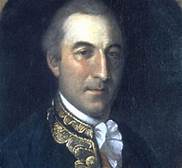
In his book, Travels in North-America, in the years 1780-81-82, Chastellux tells how he visited Thomas Jefferson, and then the next day he visited Steeles Tavern. What a lovely coincidence for anyone searching for ancestors! If only everyone on my family tree would have such a connection. What better way not to be forgotten? Chastellux set out on horseback from Monticello to cross Afton Mountain through Rockfish Gap, hunting along the way “what the inhabitants of the mountains call a pheasant,” and traveling forty miles before spending the night at a tavern near Waynesboro. Mrs. Teaze ran the tavern, a poor widow who might’ve been Robert Steele’s sister, Martha Steele Teas. Although Jefferson had made the recommendation, Chastellux proclaims that Mrs. Teaze’s public house was “one of the worst in all America.” He offers several explanations for this poor rating that indicate extreme poverty (along with hygiene deficiency), but he delivers this information as though expecting his readers to consider his discomfort the real tragedy, not Mrs. Teaze’s dire situation. I will offer an observation that is perhaps the most telling and the most snooty: “A solitary tin vessel was the only bowl for the family, the servants and ourselves: I dare not say for what other use it was proposed to us on our going to bed…It may easily be imagined we were not tempted to breakfast in this house.” (Quotes are from Travels pages 243-246)
The next morning Chastellux and his party continued to the Smith tavern, which was the cabin my first Steele immigrant, Janet Steele, moved to when she remarried after her first husband David died. The cabin still stands in Greenville today. Here Chastellux encountered more poverty. “Mr. Smith, a poor planter, to whom we were recommended, had neither forage for our horses, nor anything for ourselves.” Smith sent the group eight miles south to the Steele’s tavern where he met David and Polly Steele. Chastellux and his traveling companions must’ve been relieved to reach a tavern where they could rest and feed their horses and themselves.
Chastellux describes Polly as “young and handsome.” But he saves his most elaborate description for David’s appearance. “He was a young man 22 years of age, whose charming face, fine teeth, red lips and rosy cheeks, recalled to mind the pleasing portrait which Marmontel gives Lubin.” (Marmontel was a French writer.) “His walk and carriage did not, however, correspond with the freshness of his looks, for he appeared sluggish and inactive. I inquired the reason and he told me he had been in a languishing state ever since the Battle of Guilford in which he had received 15 or 16 wounds with a hanger.”
After David explained about the scar on his forehead, Polly fetched David’s skull bone to show Chastellux. “He had not, like the Romans, a crown to attest his valor [but instead] a piece of skull…This unhappy young man acquainted me, that overcome with wounds, and wallowing in his blood, he yet retained his presence of mind, and imagining his cruel enemies would not leave existing a single witness or victim of their barbarity, there remained no other way of saving his life than by appearing as if he had lost it.”
Polly and David couldn’t offer the travelers bread since the kneaded loaves hadn’t finished baking. They didn’t offer liquor since “the house made use of none,” (which is a sign to me that they held firm to their religious convictions since staunch Presbyterians didn’t indulge in drink). There seems to have been no extra food to offer since Chastellux writes that the “same stream which turned the mill was the only cellar of the young couple.” Polly did offer hoecakes, which satisfied the men. “A few cakes, however, baked upon the cinders, excellent butter, good milk, and above all, the interest with which Mr. Steele inspired us, made us pass agreeably the time, which was necessary to put our horses in condition to perform a long, difficult day’s journey.” After resting for the afternoon, they left Steeles Tavern and headed toward Natural Bridge, already a famous landmark.
When I first read this account in Aunt Mildred’s book, I found the tale riveting. How strangely wonderful to read about a particular day in the life of an ancestor, especially one recorded by a writer who knows how to sling a fancy phrase and throw in the details. I now have a visual portrait of David and Polly. Not just what they looked like but how they lived their lives with their hoecakes and missing cellar and amiable conversation with strangers who visited their spare home. But can I believe this interpretation of the scene? All stories come to us through a particular lens. Even the telling of history, which is essentially a collection and interpretation of various stories, comes to us through a subjective viewpoint. Chastellux gives us a picture that’s so quaint and romantic, it’s almost insulting in its romantic, pastoral vibe. At the time of this encounter, Polly’s brother was working for President Washington, with whom Chastellux often met during the war. I doubt that she made this relationship known to her visitor. Chastellux would’ve surely recorded such an interesting tidbit in his book. I wonder what my Scots-Irish ancestors made of this educated Frenchman? Did they pigeonhole him, too?
As we move from the second generation of Steeles to the third generation—that of Polly and David Steele—the fog lifts for both the women and the men. These people firmly belong to history. I know a great deal about David who fought in the Revolutionary War, built a mill and began the long family tradition of running a tavern. I don’t have the elder Polly’s voice on paper, but I have letters that mention her, and a few lines by Chastellux that describe her appearance, demeanor, home and lifestyle. Between the second and third generation of Steeles, we move from the effects of the French and Indian Wars on the Valley to the American Revolution and the Industrial Revolution. The Valley changed radically during these two generations, transforming a backwoods area without roads or even wagons, to an area of settlement and commerce where towns emerge. Lumber and flour mills, forges, tanneries, stores, and taverns begin to dot the landscape. By the time David and Polly’s grandson, another David Steele, ran the tavern and mill at Steeles Tavern, the Valley had become the “Breadbasket of the Confederacy.” The courts and businesses leave us easy trails to follow, offering clues about my family. Beginning with Polly and David Steele, the path of my ancestors becomes much easier to navigate.
I can’t know what Polly and David thought of Chastellux but I do have a record of David’s thoughts about more personal matters. David’s eldest daughter, Jenny (born before the Battle of Guilford) married George McCormick, the uncle of Cyrus McCormick, the inventor of the reaper, and moved to Kentucky. Through David’s letters to Jenny, we discover David’s written voice and some of his cares and concerns, including his perspective upon his wife, Polly.
Addressed to George McCormick, Scott County, Kentucky:
Augusta County
September the 12th, 1803
Dear son and daughter:
I now sit down to write to you to inform you of our welfare. There has nothing in particular happened in the family since you left this place. Aggy died a few days ago. I have not had my health very well since you saw me. Your Mother has had her health better than common. John goes to school and is learning middling smart. You wrote to me to know if the place is sold; It is not sold nor no probability of its being sold. You mentioned to let you know whether you might venture to purchase on Dependance from me, how soon and in what manner. As to that I cannot inform you. I did expect to send what I suppose you meant by your brother James; but being disappointed in Collection I cannot send more than about one hundred dollars. I expect to send you more money by Peter Alexander. He intends starting in three weeks. Jenny mentioned to send her some coffee, if any opportunity. I suppose I will send it. It sells for two shillings and three pence per pound at this time. As to the times and seasons in place I suppose James can inform you. I add no more but wish to be remembered to the children. David Steele
Jenny mentioned a negro girl. I suppose that will come as soon as can conveniently.
David’s letter gives us an impression of a loving family, connected to one another in spite of the geographical distance. David worries about money. He promises to send coffee to Jenny, maybe sell a parcel of land. Then he tacks on a line at the end of the letter that has forever changed my picture of David and Polly Steele. For me, his descendant of the generations, David has slipped from honest yeoman to possible slave holder. This sometimes happens with genealogy research. Our ancestors won’t remain in the cubbyholes we place them.
David wants Jenny to send along a slave. How disturbing! He uses the word “that” to refer to a young girl. Perhaps he wanted a servant to help his wife in her declining years. According to family letters, Polly had known poor health for much of her life. Having an invalid husband added to her pains. David wanted to find help for his ailing wife. He wanted a slave girl to help out around the house, not a local girl. Was this “negro girl” the first slave in the Steele family?
Few settlers owned slaves in the Valley in those days. Plantations on the coastal side of Virginia relied on slaves, but even during the Civil War, far fewer slaves resided in the western side of the Blue Ridge Mountains. We can assume that if Jenny had a slave girl to spare to send to her parents, she and her husband, George, must’ve owned slaves in Kentucky. This letter indicates that the Steeles owned and sought to own slaves. Any slaves in the household would’ve influenced the lives of the Steeles. How could they not? Living in such close quarters, people can’t remain indifferent to one another’s attitudes and actions. But unlike the partially recorded histories of the Steele’s neighbors and kin, any slaves added to the household have remained ghost-like to me. On what genealogical site can I find their presence?
Five years after this letter requesting a slave girl, David informed Jenny about his financial worries. He doesn’t mention a slave again.
We still continue near as you left us, very scarce of money…We have had a very bad summer season and the frost I think has kill’d all the corn in the neighborhood. We have no price here for anything we raise since the embargo took place…There is great debating in Stanton about the embargo, some for and some against it.
David mentions the Embargo Act of 1807 that prohibited American ships from trading in foreign ports. Even this small mention sheds light on my family. The embargo and following war with Britain greatly affected the Steeles. With the embargo, Jefferson had intended to punish Britain and France for interfering with American trade. But as agricultural prices and earnings fell, American shipping-related industries became devastated. Much of the Valley suffered financial setbacks, as did my family, but the next generation reaped the rewards of a forced change. The embargo and war revealed the need for economic independence, which included a better transportation system and independent markets. Good roads meant goods could be transported easier and faster while American markets opened doors. David struggled financially, but his son, John, and his daughter, Polly, who remained in the Valley, began to reap substantial rewards of the countries readjusted priorities brought on by the embargo and war with England.
In one of his letters, David tells Jenny that her younger brother, John, studies with Parson Brown (the son of aforementioned Rev Brown and the captive Mary (Polly) Brown). Polly went to school in Lexington. Her letters to Jenny reflect a substantial education, especially for an eighteenth-century woman. Even though he worried about money, David made sure that both of his children became educated.
Polly gives us the first female voice of the Steele family. She would’ve impressed Chastellux with her flowery, dramatic style. When she tells Jenny why she couldn’t come to see her in Kentucky, she reveals a winsome, passionate, somewhat pushy personality.
April 16, 1807 Augusta City
Dear Sister:
In my last letter to you I mentioned my sickness, which prevented me from going to Kentucky. I then calculated on going in the spring, but spring brings reasons with it to stop me which shows the fallacy and precariousness of all human expectations, for I had long vainly flattered myself that I was to see you before this time which idea gave me infinite pleasure, but I am disappointed for the present. However, I still hope to see you though I know not when.
I am so anxious to hear from you that I have sometimes thought of not writing to you again until I receive a letter from you. It is almost a year since I have seen a line from you, and I still think you have written and your leftes have been miscarried. Write to me the first opportunity a long account of your family, of their growth, their progress in learning, and what you are all about, for the perusal of each letter must always give me pleasure to a sister who feels as much interest in your welfare as I do.
Polly goes on to shed light on the ways of women in the Valley. To scatter ghosts-like tenancies among the Steele family, I can read her letters instead of relying completely on historians who offer a more impersonal history. Polly touches on many of the themes I’ve been trying to uncover, helping to reveal my female relatives more clearly: friendships, marriages, the delivery of babies, illnesses and deaths, all these topics are covered in her letters. “I send my most hearty congratulations to you on being the mother of another son and likewise on your recovery from the illness attendant on his birth.” She writes about the female world where she spent her life, but also about how the lives of men were affected by women.
In February your mother-in-law died after a long illness: and not many weeks before her death Polly McCormick, with one of her children departed this life about the days of the birth of the infant aforementioned. Uncle William Moore has conditionally sold his possessions and talks of moving to the westward, but in all probability his purchaser will not comply with his contract, and if not he must make a new sale before he moves. His family is all single yet except Jenny Forsithe, and lives almost one mile from her father. She has no children. Peggy Paaze and her sisters are single yet and are very well. Last week I was at the marriage of Catherine Steele, youngest and last daughter to marry of Thomas Steele. She married Thomas Jackson. All the other matches that have taken places in our connection I have mentioned in letters previous to this. There is no alteration in this family. John goes to school. Your father had a severe attack of the rheumatic pains, but has recovered, and we are all enjoying health and contentment. Your mother is heartier than you ever knew her. Give my love to George and the children. I remain you loving sister. Polly
Another correspondent sheds additional light on David and Polly’s generation. Jenny and George had eight children, and their son, John, visited Steeles Tavern in 1838. John writes to his mother in Kentucky: “Grandmother has been dead four years. Grandfather is living and is well.” Had no one told Jenny that her mother died?
Questions can also lead to clarity. The picture of lost communications between Jenny and her family in Steeles Tavern adds a different perspective on the two families. With these letters, the historical lens trained on the Steele family begins to gain focus. In the succeeding generations, the Steeles both the women and men will come more clearly into view.
My ancestor, John Stele, brother to Jenny and Polly, studied law in Fredericksburg, although he never practiced. At his parent’s urging, he came home to Steeles Tavern to take over the tavern and mill. He married Eliza Moon and raised a family of twelve.
What happened to Polly? Although she’s not one of my direct ancestors, her letters make me feel as though I know her. Polly married her cousin, Robert Steele, the son of Thomas Steele, who was born after his father, David, died. (David was the first Steele in the Valley.) Robert built Polly a brick house in Greenville that’s the subject of Michael Shutty’s book, An Old House in Greenville: A Study of Human Intention in Vernacular Architecture, a book I’ve read serval times and previously mentioned in another posting.

My ancestor, John, Polly’s brother, built a brick house in Steeles Tavern for his wife, Eliza Moon. As two of the earliest brick houses built in the Valley, Polly and Johns’ homes signaled new prosperity for the Steeles. These homes still stand today, although Polly’s house in Greenville has worn better than John’s house in Steele’s Tavern. When I took my friends, Connie and Robin, to Steeles Tavern in November, we found John and Eliza’s brick house empty, but even so, a forlorn grace still lingered about the place. The house, relocated after the widening of Rt 11, once boasted a fine garden and a white picket fence, flanked by an apple orchard. My friends and I peeked into the windows to admire the banister and the wood floors. The Steeles remained in this house for three generations. In the early 1900s, my grandmother, Edith Steele Searson, often visited the house to see her grandmother, Molly Smith, who made sure there were always molasses cookies waiting for her grandchildren. Several family homes remain in Steeles Tavern, and these houses offer me a physical representation of the lives of my ancestors, reducing the ghostliness of my past.


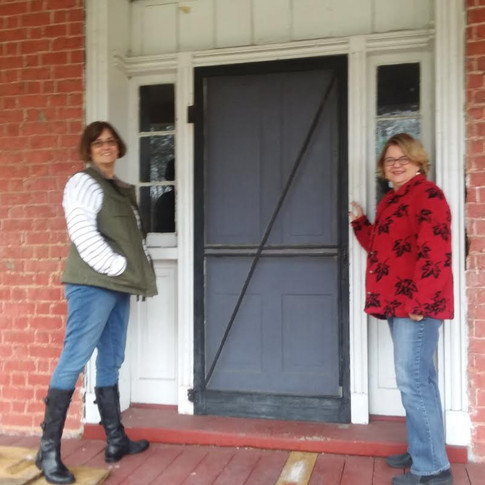
(Connie and Robin snooping around Eliza and John Steele's house.)
But again, what happened to Polly? According to Aunt Mildred, before running a “thriving business” in Greenville, her husband, Robert and his brother, William, ran a store in Lexington. The mercantile records of her their business dealings reveal a comfortable life for Polly, albeit a short one. Polly died in 1821, at the age of thirty-two, leaving two young daughters, Jennie, age 6, and Mary, age 4. Her death saddens me. If I had encountered the statistics of her life before reading her letters, my reaction to her early death would’ve been muted. Names and dates on paper do not elicit much of a reaction from me. But Polly seemed so real and alive as she penned those letters. Through Aunt Mildred, I discover that Polly’s husband, Robert, married twice more. Polly’s daughter, Jennie, married a physician and moved to Mississippi. Mary married and moved to Texas. Polly Steele left no descendants in Virginia. My line of the Steeles remained in Steeles Tavern until my father moved away, but with each generation more family members moved out of the state, scattering across the country. So many cousins to pursue!
Not that I intend to mine the depths of these connections. I

shudder to think how many sleepless nights such research would entail. But a few brush strokes at the periphery of the Steele family’s portrait has added depth. With the third generation of Steeles, a deeper, richer portrait of my family has taken shape. Given time, the women and men of my Steele family tree might cast off any ghostly apparition to eventually appear as full-blown, clearly outlined, former earth-dwellers to me.
_____________________________________________________________________
by Barbara H. Lewis riteme4@gmail.com
To read a free copy of Travels in North-America, in the years 1780-81-82, by François Jean de Beauvoir, Marquis de Chastellux go to:
https://archive.org/details/marquistravels00chasrich/page/244
or
https://www.loc.gov/resource/lhbtn.06665?st=gallery&c=80
A history of Rockbridge County, Virginia, by Oren F. Morton:
https://babel.hathitrust.org/cgi/pt?id=uc1.b3623674;view=1up;seq=7
Comments