


Someplace Else

My Steele family line remained in Steeles Tavern for over two hundred years, but that doesn’t mean they weren’t restless or adventurous. They pursued the American Dream, striving to achieve personal goals and provide for their children. Even if they wanted to conserve the past that had been created for them by their forebears, life around them kept altering, shapeshifting and redirecting their paths. History happened. Friends and family also moved away and wrote back to them about new frontiers, upending their own narratives. The Steeles of Steeles Tavern kept having to react and change and make do with the new. In that way at least, life has remained much the same for their descendants, including yours truly.
Here's the short version of our family saga: David Steele first settled Steeles Tavern and died leaving a pregnant wife, Janet. One of his sons, Robert, married Elizabeth (and then Mary) and raised seven children in Steeles Tavern. Robert and Elizabeth's son, the second David Steele in my line, married Polly Moore Steele, and ran a mill and tavern. David and Polly's son, John Steele, studied law but never practiced, coming home instead to care for his aging parents. John married Eliza Moon and fathered twelve children. John’s son, the third David Steele in my line, inherited the property in Steeles Tavern right before the Civil War, managing to pass along land and property, including two mills, to his two surviving children, Irene and Frank. Walter Searson emigrated from Stamford, England, to work for the McCormick family, marrying his neighbor and an old family friend of the McCormick’s, Irene Steele. Irene and Walter’s seven children, including my grandmother, Edith, were raised on the lovely and gracious McCormick farm. Edith married Erskine Hawpe, the son of a prosperous cattle farmer who she’d known all her life. Erskine and Edith’s son, Kemp, grew up in Steeles Tavern during the Great Depression, attending a one-room schoolhouse, and living in one of his grandmother’s rental properties. Restless and longing to know the larger world outside of the confines of his small town, Kemp joined the war effort, serving as part of the invading army in Japan. After the war, Dad joined a modern-day wagon train of veterans who left family farms for the suburbs. He never returned to Steeles Tavern, raising his two children, me and my brother, Mark, in Richmond, Virginia, and seldom making the two-hour pilgrimage back home. We belonged to the future, growing up knowing only fragments of our family’s past. Like other Steele descendants, we left Steeles Tavern for somewhere else.
Until my father’s departure, my line of the Steeles remained in Steeles Tavern, but within each generation, some Steeles left town. Wagons kept rolling across the Alleghenies toward the western frontiers, and Steele cousins joined in the westward expansion, settling in whatever happened to be the latest and most promising newly opened frontier—Kentucky, Ohio, Missouri, Indiana, Texas, California, Oregon, and my adopted state of Washington. Many of these immigrants wrote home to my ancestors, and my family preserved their letters. Collectively, these correspondances offer a personal lens through which to view the unfolding of America.
How did the family letters from Kentucky and Missouri and California challenge my relatives' views of themselves back home in Steeles Tavern? Did they see their small world differently as they gathered news from distant lands? When William Hopkins wrote home about the gold to be had in California, urging his brother-in-law, the third David Steele, to join him in Solano County, did David think William a fool? Did he envy him? Did David long to uproot himself and travel west but felt he couldn’t because of family responsibilities? Was David content to stay home or restless like so many of his siblings?
My life choices indicate a certain restlessness. In spite of my affection for Virginia, I moved away by choice. Like the words of the plaintive folksong, I joined the throngs of Americans who crossed the wide Missouri.
Oh, Shenandoah,
I long to see you,
Away you rolling river.
Oh Shenandoah,
I long to see you,
Away, I'm bound away,
Across the wide Missouri.

For a gorgeous renditions of Oh, Shenandoah! by Sissel Kyrkjebø go to: https://www.youtube.com/watch?v=W1EG_4IBzbA
“Americans have always had itching feet.” Restlessness is part of our national character. Even before the Revolution, four out of ten households relocated every ten years. Pioneers were especially mobile. Many of the earliest settlers inhabited a place for a few years and then moved to a new frontier. People relocated for various reasons. They moved because they were financially strapped, or they dreamt of finally owning land. Some landowners moved because they could afford to buy larger tracts of much better land in the new frontiers. Virginians often hoped to recreate the life they’d experienced back home. Some Virginians from the Tidewater, Piedmont, and Shenandoah Valley brought slaves with them to Kentucky and Missouri. Enslaved people had no choice about immigrating.
Historians have long debated the significance of America’s western expansion. Frederick Jackson Turner believed that the frontier shaped the American character. He asserted that Americans became more democratic than Europeans and less conscious of class as a result of settling western lands. Other historians claim that societal habits die hard and settlers often took their cultures with them. Southern planters established islands of southern culture in various frontiers, like parts of Kentucky and Missouri where the Steeles migrated, shaping the land to fit their expectations. Some historians point out that Turner's portrayal of the frontier was far too romantic. What about the conquered American Indians? Displaced Mexicans? Marginalized Asians? The forced servitude of slaves? Even white settlers could become marginalized when western frontiers became short on capital and burdened by federal regulations. Just who were the conquerors and what had they conquered?
I've been thinking about the American Dream as I continue to research the Steeles. Immigrants like the Steeles crossed the Atlantic Ocean for a slice of some kind of dream. That dream persisted as their children’s children settled the West. Like their European ancestors, western settlers longed for land and social prestige, or at least a livelihood that would support a family, although sometimes they were just restless and wanted adventure. Take your pick. Those who prospered in new frontiers were usually glad enough to accumulate modest fortunes over the years. Then came the California Gold Rush of 1849 when a new dream emerged: great wealth could be had with luck and hard work. This wealth could be attained within a few years, not in several generations.
Since then the American Dream seems to have alternated between the more modest expectation of a job and home ownership to the grandiose California Dream of quick riches without longterm, persistent effort. My convivial older brother, Jack, often regaled us at family gatherings with wild stories about men (these stories were always about men) gaining great wealth with luck and little effort. Jack later invested in California tech companies that unfortunately failed him. My father, on the other hand, a survivor of the Great Depression, carefully invested his modest salary (and my mother’s small inheritance) motivated by the American Dream of home ownership, education, and providing for his children. As newlyweds, Brian and I thought we could either choose the simple life or work hard and send our kids to private schools. We just had to decide what we wanted. Isn’t that the American Dream? To think we can choose?
The Steeles reached the Shenandoah Valley in the 1730s as part of a Scots-Irish exodus from Northern Ireland. By coming to America, my ancestors hoped to escape the economic hardships and social repressions in Ireland, consequences of British domination and oppression. As Presbyterians, the Steeles and their neighbors wanted to find a place where they could practice their faith, work their own lands, and be masters of their own fate. Being free meant nobody could boss them around. The Steeles fought for this version of the American Dream, first combating the America Indian and then the British. They fought their own countrymen during the Civil War. The wealth of my ancestors grew most between the Revolution and the Civil War. Even after the war, they managed to hold onto their property until the Great Depression. Irene died without a will, leaving her children with meager inheritances.
Irene Steele Searson, my father’s grandmother, built a grand home in Steeles Tavern, no doubt fulfilling the expectations of six generations of her Steele forebears, only to lose her modest fortune during the Depression. Consequently, my father grew up with a revised version of the American Dream. He wanted to go to college, buy a home, and support a family. He left Steeles Tavern for Richmond because his options were limited in the Valley—and because he was restless. Dad certainly had itchy feet. He couldn't wait to leave Steeles Tavern.
He wasn't made for country life. One of his chores growing up was to care for his grandparents' sheep, who he claimed gave him flea bites. I have a wool blanket from those same sheep that's over a hundred years old. My daughter, Heather, has immigrated to Vermont where she and her husband, Ian, live in a log cabin and raise chickens and goats. They're committed to homesteading. My dad would find this scenario amusing since we have come full circle.

Ian, Heather, and Aine Devine
*
The story of the Steeles includes the restless ones. Between 1785 and 1807, Steeles moved to Kentucky, settling in Jessamine and Henderson counties, a journey of four hundred miles from Steeles Tavern. Moses Steele relocated to Kentucky around 1785. Janny Steele Cunningham moved to Jessamine County in 1788. Around 1801, Jennie Steele, the second David Steele’s daughter, moved with her husband, George McCormick, to Henderson County, Kentucky. (George McCormick was the uncle of Cyrus McCormick, the inventor.) Sarah Steele Campbell joined her Steele cousins in 1805.
Most of the early pioneers to Kentucky were Virginians. When they reached Kentucky, they found “an extensive garden” with black soil growing walnuts, elm, oak, and hickory trees that held the promise of fertile farmlands. Hunters found deer, bears, turkeys, geese, ducks, pheasants, squirrels, and rabbits, and also wolves, and wild cats. Plentiful bounty to feed a family and provide for a brisk trade in pelts. There were also large swaths of land free of trees that proved excellent for raising cattle. Settlers also grew corn to feed hogs and distill into whiskey. People lived in isolated settlements connected by trails “beaten by wild animals meandering through the cane, pea-vine, prairie grass, and forest undergrowth,” making any journey difficult and dangerous—and providing outlaws an easy getaway.

Settlers heading to Kentucky
*
My relatives weren’t part of the early days. They came a few years later when Kentucky became more civilized (and the Native Americans had been removed or marginalized.) The hunting stage of frontier life gave way quickly to the cash crops of tobacco, corn, and hemp. Having exhausted much of the Tidewater’s agricultural lands, Virginia planters hoped that the virgin soil of Kentucky would yield tobacco. (Having ruined their own land, they sought to ruin Kentucky’s.) Population growth was a factor in leaving pioneer days behind. By 1790, one hundred thousand Americans lived west of the Appalachians. Some fifty years later, seven million people occupied the same landscape. Newly settled lands didn’t remain frontier-like for long. Former neighbors and fellow churchgoers from the Valley, joined George and Jenny Steele McCormick on their pilgrimage to Kentucky, allowing for a quick recreation of the culture of the Valley.
George McCormick owned and operated one of the first grist and saw mills in Henderson County. When Steele family members left the Valley, they probably expected never to return. Many corresponded with one another, discussing family and financial matters, crops and politics, and often begging to receive more letters from loved ones. Jennie’s father, the second David Steele, wrote to his daughter in Kentucky with candor: We still continue near as you left us, very scarce of money…We have had a very bad summer season and the frost I think has killed all the corn in the neighborhood. David’s younger daughter, Polly, sent excuses about why she hadn't come to visit her older sister, Jennie, revealing both her education and her philosophical inclinations: I then calculated on going in the spring, but spring brings reasons with it to stop me which shows the fallacy and precariousness of all human expectations, for I had long vainly flattered myself that I was to see you before this time which idea gave me infinite pleasure, but I am disappointed for the present. However, I still hope to see you though I know not when.
Polly Steele never made it to Kentucky. She died as a young mother in Steeles Tavern. Polly’s husband, Robert Steele, her cousin, remarried and moved from the Valley. Their daughter, another Jennie, left the Valley for Mississippi. Polly, Robert and Polly’s youngest daughter, relocated to Texas. After the elder Polly Steele’s death, the letters to Kentucky seem to have stopped. In 1838, Jennie sent her son, John Steele McCormick, to Steeles Tavern to check on his elderly grandparents. John wrote back to his mother in Kentucky: Grandmother has been dead four years. Grandfather is living and is well.
Why had no one written to Jennie about the death of her mother?
Decades would pass before Jennie’s granddaughter, Nannie Coleman, reconnected to the family in Steeles Tavern. (Nannie McCormick Coleman authored the book, “The Constitution and its Framers.”) Nannie told Aunt Mildred that her father had been named after our ancestor, John Steele, brother to Jennie (who moved to Kentucky) and Polly who remained in Steeles Tavern and died young. John Steele, my ancestor who ran the mill and farm in Steeles Tavern before the Civil War, was “a bright man, a lawyer,” Nannie wrote. “We have some of his letters written to his sister after she moved to Kentucky.”
I wish I could read those letters! Where are they now? Does some distant cousin keep them in a box in her Kentucky closet? Does she know about John Steele? Has she heard of Steeles Tavern?
Cousins continued to move away from the Valley. Mary Steele Westcott left the Valley for Indiana as did Mary, Nathaniel, and Nathaniel Steele III; Carden journeyed to Tennesee; Robert to Kansas; John to Illinois. Another Robert Steele traveled to Kansas; a John Steele moved to Cranford, County, Illinois.
The name “John Steele” keeps turning up in our family tree. In 1798, Cousin John Steele, the Secretary of the Mississippi Territory, wrote to his father, Andrew, from Natchez. This particular John Steele never returned to make his home in the Valley either. He remained out West after his official appointment ended. Our family held onto his letter.
Honored Sir…I embrace [the opportunity] to inform you of my safe arrival here…after a passage of seventy-one days…Almost equal to a voyage from Ireland to America…I presume from the observations I have already been able to make from the faces of the inhabitants that the country is much more healthy than I had supposed. I have been honored with a most friendly and polite reception by all who I have seen—and flatter myself that my situation here will be an agreeable one so far as it depends on the people to make it so.
Lineage reminder: David-Robert-David-John-David-Irene
Let’s include the women: David and Janet begat Robert, who married Elizabeth and fathered the second David, who married Polly Moore and fathered John, who married Eliza Moon and fathered twelve children, including the third David who married Molly Smith. Their daughter, Irene, married Walter Searson.
Seven of John and Eliza Steele’s twelve children quit the Valley. As teenagers, Richard and John D. Steele traveled to Burton, Alabama with D. A. Steele, a cousin of their fathers who had come to Virginia to buy slaves. The boys wrote home begging their brother and sister, David and Charlotte, to write to them. Charlotte, for her part, married Judge James R. Davis and moved to Missouri, along with Charlotte’s sister, Fannie. In 1842, Charlotte was residing in Solano County, north of the Missouri River in Black Water Township in the central section of the state when she wrote home alarmed about the beating death of a neighbor’s slave, Rachael. “Nothing has happened like this in the world!”
The last letter from Isaac Steele arrived from Ft. Yuma, Arizona in 1859. Isaac had found a wife while visiting his sister, Charlotte, in Missouri, but he’d left her to join the army. Years later, Cousin Nellie wrote to Aunt Mildred about Isaac: “At any rate, he was quite a character…I know he was pretty wild. My mother said he was the only black sheep in our family.” In 1876, wild Isaac died with Custer at the Battle of the Little Bighorn.
James and Charlotte Steele Davis (daughter of John and Eliza Steele of Steeles Tavern) raised six children on their farm in Missouri. James ran for office, serving as a judge for Solano County. Why did James and Charlotte Steele Davis pick Missouri? What was going on there to entice the couple away from the Valley?
Daniel Boone had led an expedition through the Cumberland Gap, opening the Appalachian Mountains near a junction of modern-day Kentucky, Virginia, and Tennessee. Hundreds of thousands of settlers eventually used the Valley Pike on their way to Cumberland Gap, many passing through Steeles Tavern. Wouldn’t that be enough to kindle some healthy curiosity?
But why Missouri?
Lots of Virginians moved to Missouri (and Kentucky). James and Charlotte counted extended family and old Valley neighbors among their connections. So many Virginians (or families with old Virginia roots) moved to Missouri that a part of the territory along the Missouri River became known as Little Dixie.

Migrants from the hemp and tobacco regions of the South rolled into the Missouri Territory intending to recreate their former way of life, a complex cultural heritage that including slave ownership. On average, Missouri’s slave population ran around ten percent, but in Little Dixie before the war, slaves made up as high as fifty percent of the population. Even though Charlotte became alarmed when her neighbor killed his slave, Charlotte and James owned two slaves, a mother, and a child.
Early settlers to Missouri remained divided about slavery. The historian, John V. H. Dippel, has suggested that one of the main reasons poor white farmers traveled to Kentucky and Missouri was to escape the plantation system. In states like Virginia, small farmers couldn’t compete with the large plantations made possible by slave labor. Some of these farmers resented having to move away from their former homes and sought ways to prevent slavery from taking hold in new territories. Other settlers found slavery morally repulsive and wanted the institution outlawed. In the end, Missouri was admitted to the Union as a slave-holding state, but conflicts continued for many years, becoming a precursor of the Civil War.
Charlotte Steele Davis moved to Missouri with her husband, James, for reasons that her letters don’t reveal. Religious life, which certainly helped to create a sense of community in Kentucky and Missouri, would’ve been important to Charlotte. The Steeles remained religious for generations. Education also remained a priority for the Steeles as Charlotte’s letters reflect. Like most settlers, Charlotte probably moved to Missouri expecting to find better prospects for James and their children in a promising new community that felt like home.
While Charlotte put down roots in Little Dixie, her younger sister, Annott Steele Bland, moved to California, with her husband, Henry J. Bland, a Methodist minister. The couple arrived in Solano County less than ten years after the 1849 California Gold Rush. In addition to serving in the ministry (preaching to unruly miners) Henry ranched for a time in Solano County, northeast of San Francisco. Since the transcontinental railroad wasn’t completed until 1869, Annott and Henry traveled on a steamer around the tip of Cape Horn, suffering tragedy along the way when their young daughter died and was buried at sea. Their two surviving children, a son, Henry, and a daughter, Mae, were born and raised in California. Henry Meade Bland grew up to become the Poet Laureate of California, sharing a friendship with Jack London and John Muir. A child of restless pioneers, Henry loved the spacious, wild places of California. He wrote verses venerating the pioneer: “With a sign for the unknown land fevering his brain…He crossed the Divide…No flood of the dark Missouri…could wreck his dream.”
California specialized in the restless. Unlike the settlers of Kentucky and Missouri, the folks who arrived in California in the mid-nineteenth century didn’t intend to recreate their former way of life. They sought to experience a new way of life. They wanted to go somewhere else and do something else. They dreamt big. The dream of California remained tethered to the land, to the mind-bending vistas and wide, open spaces. The great sweep of beautiful, unsettled land encouraged Californians to think of themselves as “people animated by heroic Imperatives,” says the historian, Kevin Starr. California became a land of contradictions. Following the general notion of cutting loose and striking it rich, says the writer Joan Didion of her home state, the area attracted drifters rather than cultivators. Perpetual pioneers, instead of ardent settlers. Even Didion’s mother found California “too regulated, too taxed, too expensive.” She spoke enthusiastically about moving to the Australian outback.
I have always found California to be confusing. My husband, Brian, and I once lived in Pasadena with our young daughter, Laura. (We drove across the country pulling a small U-haul filled almost entirely with toys.) Yes, the land could be beautiful, but for the first two weeks, we didn’t know we had a view of the San Gabriel Mountains because of the dense smog. Driving outside of Pasadena was a brutal experience. But we fell in love with Yosemite. When I ask Brian what he remembers about California, he says, “The sun and the feeling of hope everywhere. I still think of our time there as a great adventure.” Once we took a train back from Virginia, and as we entered California, the dull brown of the desert exploded into vibrant green vegetation crowded with flowers of all hues—magenta, purple, yellow and orange—a marvelous sensory overload that I have never forgotten.
Mary, and her husband, William Hopkins, decided to relocate to California after Union troops burnt down the family store and destroyed much of their property in Steeles Tavern.“Yankees took everything, burned all the account books and broke up the business," Cousin Nellie, a Steele descendant, would write to Aunt Mildred. After they moved, William wrote to his brother-in-law, the third David Steele, urging David to join him in California. “Gold is everywhere.” But David chose to stay in Virginia. Then Mary wrote home to Steeles Tavern, imploring her brother to help them buy a farm. California proved to be an unfulfilled dream for the Hopkins. They never landed on their feet again. The gold that was everywhere around them never made it to their pockets.

Solano County today
Three children joined their parents in California—Jennie, Orie, and Nellie Hopkins. (Two children died of diphtheria in Steeles Tavern.) Jennie, the eldest, married the Englishman, Sam Bradshaw, who had immigrated to California after the gold rush. Unlike Jennie’s parents, the young couple prospered in California, owning a ranch and selling meat out of their store. But then Sam grew restless and decided to move to Washington. Years later, Sam and Jennie’s granddaughter, Beatrice, would write to Aunt Mildred, confiding that she never understood why her grandparents gave up their prosperous ranch and store to homestead in the middle of nowhere.
Dad had a meat shop and ranch and why they sold one and went to Walla Wala, back in the hills and homesteaded, I never could understand. They had quite a bit of money. Gold, at that time and they made a belt for each one — Nellie was with them —sewed the money in the belt. I have heard them say how heavy it was to carry.
Jennie’s sister, Nellie, also tried to explain the move to Aunt Mildred.
My sister Jennie married (Sam Bradshaw) in California…He took to the idea of going to Washington Territory in 1881. It was all Government land of course…He got many hundreds of acres of that land and bought cattle and horses and farmed on the Virgin land. That I can tell you was real pioneering…I took to Horses and Cattle. I could ride the Range and Lariat a steer as good as any cowhand. I learned to ride and break the wildest horses. I loved the wild life and I lived it.

Nellie Hopkins Dickhart has become my new favorite dead relative!
I was thrilled to learn that I wasn’t the first Steele descendant to live in my adopted state of Washington. But I also came to love Nellie though her letters. As a woman in her seventies, Nellie’s writing reveals a great gusto for life, a lively wit, and a charming spunkiness. She also wrote adventure stories, albeit unpublished and sadly lost to me. Most impressive of all, Nellie loved the "wild life." She took eagerly to ranching. As a teenager, she lassoed steer and broke wild horses. Can you imagine? Someone should write a story about her!
Aunt Mildred reconnected with Nellie after finding an old address in her grandmother Mollie Steele’s papers. Nellie had given up on hearing from her cousins in Steeles Tavern again. “It is impossible for me to tell you the real pleasure your wonderful letter gave me…Dear Aunt Mollie always wrote us and kept us posted.”
I have Aunt Mollie’s letters and often read them over. We all loved her. She was such a beautiful woman both in character and features. Uncle David was much older, a bachelor and my mother would say I don’t see how Dave ever got such a beautiful wife. Aunt Mollie would call him Sir David when she spoke of him.
Tragedy struck the happy couple, my great-great-grandparents, when three of their children died of diphtheria. I have seen the graves of these children in Mt. Carmel Cemetary lined up in a neat row. Beatrice wrote: "Maggie, Ralph and Johnny were the ones that died…Nellie and Maggie had been the same age. Maggie was a beautiful girl. She took after Aunt Mollie."
I know a lot about Nellie because she wrote so many, long letters to Aunt Mildred, doing her best to fill in the gaps in the Steele family history, as well as sharing about her own amazing life. I love the details. Most of the Steeles were red-headed, Nellie wrote. “Aunt Fannie and Aunt Annott both had fiery red hair. My sister Jennie had more of an auburn red. Uncle Peter had red hair and Uncle Isaac had reddish hair.” My daughter, Laura, must've inherited the beautiful strawberry-blonde gene.
Nellie, ever the adventurer, loved to travel. Even after she left her brother-in-law’s ranch in Walla Walla, Nellie made the outdoor life her “hobby.” At nineteen, she moved to California and “married a fine man. I don’t think any better ever lived.” Since her husband worked as an auditor for the railroad, Nellie could travel with him throughout the country. She also spent time in Honolulu and Alaska. She was living in San Francisco during the 1906 earthquake.
Nellie wrote copiously to Aunt Mildred even though she was self-conscience about her spelling, grammar, and diction. Because of the many times she moved growing up, Nellie never made it to ninth grade.
I never had a College Education…I got all the Education I have from Experiences. For every Experience that I have gone through I have learned a great lesson of Natural History that I could never have learned in college. I don’t believe I would Exchange my Natural Science for a College Education.
Nellie was twelve-years-old when she left Steeles Tavern. One of her earliest memories was the destruction of the old tavern, a wooden structure built before the Revolutionary War. "I can just remember my mother and my Aunt Fannie…going over where they were wrecking it…They both started to cry. Aunt Fannie said, 'There goes the last of our old home.'"
Nellie’s grandparents raised twelve children in the brick house John Steele built for Eliza Moon. In 1818, Eliza wrote Jennie Steele McCormick, of Kentucky, John's eldest sister, that she had the promise of a home of her own in the spring.

Eliza and John Steele's house
My ancestor, David, the eldest of John and Eliza’s twelve children, inherited the lion’s share of the properties in Steeles Tavern, including the two mills. (Was that fair?) Seven of his siblings left the Valley to find homes and employment elsewhere, but David and his youngest brother, Marryotte, remained behind in Steeles Tavern. Marryotte built a gracious tavern that catered to the many horse-drawn stagecoaches traveling down the Valley Pike. This old, derelict building stands today. I’ve peeked in the windows to admire the sheen of the wood paneling and the thick wooden countertop at the bar in the front room and could easily imagine the grateful guests imbibing and enjoying a warm meal after their travels.

The second tavern, run by John's brother, Marryotte Steele
*
Aunt Charlotte was the oldest, Nellie wrote to Mildred, continuing to fill her in on the Steeles. Aunt Charlotte was “very pretty." Apparently, Cyrus McCormick "fell in love with her and wanted to marry her but Charlotte preferred James Davis.” The couple moved to Missouri where Nellie and her mother, Mary, visited them before moving to California.

Lucy Steele Davis
*
Aunt Lucy married Dr. Hamilton, who was a hard drinker, according to Nellie. "Lucy had her faults," Nellie wrote. “None of us are perfect...Poor Lucy fell into terrible habits” after marrying her no-good, hard-drinking, doctor husband. Even so, Nellie thought more highly of Aunt Lucy than she did her other aunts. “She was so good to children, always giving me something.” After she remarried, Aunt Lucy visited Nellie and her family in California. Nellie didn’t like Lucy’s second husband either. Poor Lucy.
Nellie’s mother, Mary, called her own brother, Issac (who died with Custer) the “black sheep” in the family for leaving his wife to join the army. Jennie’s daughter, Beatrice weighed in on Nellie’s older brother, Orie, calling him “a worthless person” who drank.
I’ve learned through Nellie’s letters that many of the women in my family died as suddenly as my grandmother, Edith, who fell asleep in her favorite chair on Good Friday and never woke up. "Jenny dropped dead on her way to church one Sunday morning. It was so strange. My mother (Mary) dropped dead at a meeting and your great-grandmother (Eliza) dropped over and died on the floor a few seconds or minutes after falling. Aunt Annott went to bed saying she was tired and fell asleep and died without a movement. So you see we as a family go sudden."
Is that what’s in store for me?
Through Nellie’s letters and family papers, I have also learned about writers in the family. This pleases me. Cousin Nannie from Kentucky wrote "The Constitution and its Framers." Aunt Lucy wrote and sold poetry to Peterson's Magazine in Richmond. “Some of her poetry was considered very good at the time” adds Mildred. Lucy also wrote several stories, publishing under the name Lucy Brandon. Cousin Henry Meade Bland became the Poet Laureate of California, although Nellie didn’t approve of his poetry. She considered him “a failure as a poet or as a writer” because “he lacked expression.” Others differed in their opinions of Henry Meade Bland, but Nellie maintained that Cousin Henry became Poet Laureate because influential friends recommended him for the job. For her part, Nellie wrote adventure stories based on people she knew.
As for writing, I have a lot of stories written but have never typed to publish any of them. I take my stories from real life. In my travels I have met so many different kinds of people that have told me their life story. I have taken those stories and written them and I often get them out and read them to friends and they all get as much interest out of them as if they were a real published story and many have asked me why I don’t write the real story of my life. I think sometime I will give it to someone and let them write it up. I am too old now to bother. In other words, I am just downright lazy.
Where are her fiction stories now? Are they living in a box in a long-lost cousin’s closet?
Nellie told Mildred that she longed to visit Steeles Tavern again. “My one desire is to come back to VA and see where we all come from for that is always Home Sweet Home to me.” Oh, Shenandoah, I long to see you! Nellie died before she could make the trip. Her mother, Mary, had also longed to return home. Henry Mead Bland, who’d never even been to Virginia, wanted to see Steeles Tavern. He wrote to Irene, making plans for a study trip, but never made the journey either.
I think I understand what Nellie felt about Steeles Tavern. The Shenandoah Valley still captivates me. Unlike my West Coast cousins, I’ve been able to visit Steeles Tavern after moving from Virginia. I returned to Steeles Tavern not long ago, bringing two very dear friends, Connie and Robin, who grew up with me in the suburbs of Richmond. Connie and Robin, who knew and liked my dad, agreed to accompany me on the search for my dead relatives in Steeles Tavern because as Connie reminded me, “We’re your family too.”
To reach Steeles Tavern, Connie and I drove from Richmond, passing into the Valley through Swift Run Gap, following the historical trail of Governor Spotswood and The Knights of the Golden Horseshoe, the exploratory expedition of 1716 that led to the Valley’s eventual colonial (re)settlement. (Native American tribes made it there first!) After Robin joins us from Nashville, the three of us stand on the banks of the Shenandoah River. As I look down at the muddy water with a soft blanket of fresh snow hugging the shore, I realize that I’ve never been so close to the Shenandoah River. Oh, odd! Whenever I visited the Valley, I always viewed the dark, slow-flowing stream from a car. How can I long for a river I've never known?
Early settlers took note of rivers. Travelers had to cross rivers deep and wide without using a bridge, a risky business often requiring ferry service. After leaving behind the Shenandoah River and crossing through the Allegheny Mountains (through Cumberland Gap), pioneers encounter no serious river crossing until they reached the Missouri. Bound away, across the wide Missouri!
We’re going “up” the Valley to Steeles Tavern because unlike most rivers in America, the Shenandoah River flows to the north. Steeles Tavern boasts a special relationship to the Shenandoah River. Positioned on a geographical divide, any rain falling around Steeles Tavern will end up flowing south to the James River or north to the Shenandoah River. Two different streams (both known as South River) flow in opposite directions away from Steeles Tavern. The South Fork of the Shenandoah River continues to Harpers Ferry. Steals Run, the creek that flows through Steeles Tavern, continues east to join the James River, cutting through the Blue Ridge on its way to Richmond.
In Steeles Tavern, we stop at the gas station while I try to gain my bearings. Connie and Robin are delighted to be here. “This is it? Steeles Tavern? We’re here now, right?“ I orient myself to the bridge flowing over Steeles Run with the old trees shading the water. Several houses line each side of Lee Highway (or Valley Pike, or Wilderness Road, or Highway Eleven). Absolutely no cars pass by us on this road, no matter the name. Hills and fields surround the town. The autumn air smells moist and crisp. In the distance, a dog barks.
Some years ago, I visited the Valley with Aunt Jayne, my dad’s sister. We stood on the bridge looking down at Steeles Run, water flowing over the smooth river rocks, and I reminded her how on rainy days as a young boy, my father would sit on the porch of their house hoping to see a car slide across the slippery bridge into the creek. Aunt Jayne laughed at this story.“I don’t remember that, although it certainly sounds like Kemp!”
Kemp Hawpe

***
I point out Aunt Mildred’s old house to Connie and Robin and the derelict tavern built by Marryotte Steele. We walk towards the modest brick house where John and Eliza Moon Steele raised their twelve children. Connie and Robin brazenly climb the steps to the front porch and knock loudly on the door and when no one answers, they make themselves at home and happily snoop around, peering in all the windows.

Connie and Robin snooping around Eliza's porch
*
With the widening of Lee Highway, Irene’s brother, Frank Steele, moved the house rather than have it torn down. I wonder who owns the place now? It was one of the first brick houses built in the Valley, a sign of the prosperity of the Steeles. Once upon a time, a white picket fence surrounded the house and apple blossoms spilled from the backyard. Although the house needs some love, the staircase in the foyer lends a certain grace to the old place. I can picture what it might’ve been like in John and Eliza’s day. I leave Connie and Robin fogging up the windows, and walk around to the side of the house. I’m tempted to pilfer a memento from the pile of loose bricks outside of the old chimney. When John and Eliza’s children left the Valley—seven out of twelve—this is the house that they dreamt about seeing again. This was the home they conjured when homesick in Kentucky, Missouri, California, and Washington.
After we’ve thoroughly inspected John and Eliza’s brick house (without stealing bricks or breaking into windows to have a better look around) we head to the Steeles Tavern Manor, the impressive, white-columned, stately home built by Irene Steele Searson. We climb the steps to the porch where my father once rode his tricycle. Rocking chairs beckon but we resist the urge to sit and contemplate the Valley, choosing instead to knock on the front door. The house has been run as an Inn for many years. During the Depression, even Irene took in boarders. The new owners, Ray and Melissa, greet us warmly and let us tour the house. The house looks gorgeous! We snoop and snoop. The place has been redone since my last visit, the carpet taken up and the original wood floors sanded. The Victorian decor has vanished; the colors and fabrics designs are now simpler, more refined. Although no pictures of the original interior remain to my knowledge, I’m guessing the house has never been so lovely. I suspect my father was born in one of the bedrooms upstairs. My kids stayed here overnight with me years ago. Now the memory of them mix with the imagines of my grandparent’s wedding that I’ve been told took place in the house.
https://www.steelestavern.com


Walter and Irene (far left) entertaining Cyrus McCormick, Jr. (far right)
*
We linger in the lovely sitting room, Robin examining the memorabilia lining the walls. Irene designed the house with long, low windows to catch the breeze on muggy, hot summer days, and also added a sleeping porch upstairs for sleeping on hot summer nights. The large dining room is quite elegant. Irene entertained the fabulously wealthy McCormick and Rockefeller heirs in the room. What was she thinking of building such a grand house after her children were grown? Family lore says she wanted a place big enough to receive her children. Did she need such a fancy dining room to feed her grown children? She sunk most of her inheritance into this house and subsequently lost her small fortune during the Great Depression—just as her husband, Walter, feared might happen. I share my musing with the new owners and there’s an awkward silence as if I’ve offered to string the family’s old lingerie from the bedroom windows. We’re supposed to clean up the past, forget the oddities here and there, aren’t we?
When the Depression was in full swing, some of Irene and Walter Searson’s seven children moved home to Steeles Tavern. Irene made room for them. She and her brother, Frank, inherited the town with Irene owning the properties on one side of the street, and Frank inherited the properties on the other side (which included the brick house where John and Eliza raised their twelve children). My father grew up in the shadow of Irene's grand house, living for a time in one of her old properties that had no electricity or running water, a house which has since been torn down. That’s part of my legacy, is it not? What’s the point of leaving out the family's troubles? Pain trickles down to future generations, even if we don’t know the source.
Irene’s lost fortune haunted my father. My paternal grandfather, Erskine Hawpe, struggled to find employment during the lean years in the Valley. The eldest son of a prosperous cattle farmer, Erskine seems to have been alienated from his family. When my grandparents fell upon hard times, Cyrus McCormick Jr, who was secretly in love with my grandmother, Edith, devised a plan to finance a new home for her. “It was for you, dear Edith, only for you!” After my grandparents divorced, and my grandmother sold her house and moved to Richmond, she gave my father the downpayment for the home where I grew up. So my childhood home was indirectly financed by the McCormick family. That story belongs in my legacy too.
We end our visit to Steeles Tavern by touring the McCormick Farm. The Steeles and McCormick families go back a long way. The second David Steele’s daughter, Jennie, married Cyrus McCormick’s uncle before moving to Kentucky. Another brother also married into the Steele family. The family remained neighbors for generations. The reaper was first demonstrated on the Steele farm, as Eliza Steele once testified, helping Cyrus McCormick retain his valuable patent, adding she thought Cyrus's invention was "right smart" but that it wouldn't amount to anything.
Searson girls at McCormick farm childhood home: Edith, Fair, Mildred


The McCormick Farm

Walter and Irene Searson and their children

The McCormicks and Rockerfellers visiting the Searsons at the McCormick Farm.
Walter and his wife, Irene, raised a family on the McCormick farm, where Cyrus McCormick invented the reaper. Nowadays the Virginia Tech Shenandoah Valley Agricultural Research and Extension Center owns and runs the farm. So we can snoop around without hassles! Connie and Robin are taken with the gentle beauty of the landscape, the mill house and the small pond with a wide-spreading tree. “It’s really beautiful here,” Connie says. “Your grandmother must've had an idyllic childhood.” Grandma Edith claimed she did, that’s true. She loved the place and didn’t resent growing up on someone else’s land. Irene resented it. Irene wanted to raise her children on her own land. She wanted a house of her own. But Walter kept working for the McCormick family, despite Irene’s protests. Over the years, they both wrote Nettie McCormick complaining about each other. I found their letters in a museum dedicated to the McCormicks in Madison, Wisconsin.
My great-grandfather, Walter Searson, had left his prosperous farming family in Stamford, England to accept a job offer from Leander McCormick to run the farm. Was running someone else’s farm part of his American Dream? Englishmen from proud farming families were accustomed to working other people’s land. In America, Walter married Irene, who after the early death of her father, needed a competent man to run her properties. The marriage, as my grandmother breezily told me, was no love match. That information belongs in my legacy tale.
***
Walter Searson's family in Stamford, England


***
The weather has turned cold and Connie, Robin, and I are not inclined to linger at the farm. I promise myself I will come again in May. We visit my niece, Maryann, on our way through Staunton. During the night, an ice storm covers the Valley, ghosting the trees. When Robin heads off to Nashville the next morning, Connie and I brave our way up the slippery road that leds to Swift Run Gap, bidding the Valley a temporary but grateful adieu.
We all long for roots. I know I do. I began researching the Steeles after I moved from Virginia. Researching my family ties in Virginia has anchored me as I sought to lay down roots in Chicago and Washington. My restlessness, I’ve come to discover, had its origins in a longing to find a home. Perhaps I’m not unlike the early settlers who told themselves they were searching for adventure or better prospects for their children’s future, but in their heart of hearts, were only looking for a place that felt right for them.
The geographical roots I've found in my adopted home of Washington remain tenuous. With a house perched on a bluff beside a coastal waterway, I sometimes feel that I might fly away one day, lift like the eagles that nest atop the Douglas fir behind our house and drift over the calm waters and the snow-capped Olympic Mountains peaks to soar away to someplace else.
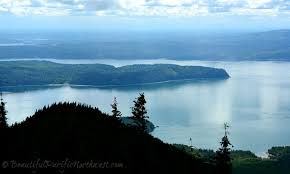
But I will not do this because my two grown kids, a son-in-law, three of my four grandkids, and Brian live here. They will surely keep me rooted! The real question? When will my grandkids come with me to visit Steeles Tavern?

Chris, Laura, Moses, Christopher, John Nathaniel, Annabelle and Yours Truly
Only the beginning...
Some books I read while writing this essay:
The American West: A New Interpretive History
by Robert V. Hine and Jack Mack Faracher
2000, Yale University Press, New Haven and London
(“Americans have always had itching feet.” p.362)
Collins' Historical Sketches of Kentucky: History of Kentucky, Volume 2
Lewis Collins
Images of Walla Walla
Elizabeth Gibson
Arcadia Publishing
San Francisco, 2004
Race to the Frontier: "White Flight" and Westward Expansion
John Van Houten Dippel
Algora Publishing, 2005
Bound Away: Virginia and The Westward Movement
by David Hackett Fischer and James C. Kelly
University Press of Virginia
Charlottesville, 2000
How the West Was Lost: The Transformation of Kentucky fro Daniel Boone to Henry Clay
Shephen Aron
The Johns Hopkins University Press
Baltimore, 1996
Where I Was From
Joan Didion
Alfred A. Knopf
New York, 2003
Comments